Football (English)
|
Written by Alessandro Nicolo
|
|
Sunday, 18 November 2007 |
Check out these goals per game averages (2002-2006) for the "Big Five" European soccer leagues:
1) Netherlands 2.97
2) Germany 2.86
3) Italy 2.60
4) England 2.59
5) Spain 2.58
You are free to interpret this as you wish. Betcha didn't think Spain would be last or that Italy would be ahead of England? As any fan of Serie A would tell you, the idea of that league being defensive is somewhat outdated now. | | No comments for this item |
|
|
Be Careful What You Wish For |
|
|
|
|
Written by Susan Hotopp
|
|
Saturday, 17 November 2007 |
|
At one time I was a regular lurker on a Manchester United forum called Redcafe. Ah, what an innocent I was! For the cost of a few hours of my time, I received a top-notch cultural education. I learned a new vocabulary term: glory-hunter. I learned that United's wild popularity around the globe didn't give every fan the warm fuzzies. And I learned that there was an unwritten rule that only the support of one's local team was appropriate. Ouch! To this naive little dismal scientist, that last one smacked of sports protectionism. The most recent era of glorious football at Old Trafford began in the 1990's. Thanks to their Champions League success and the broadcasting largesse of ESPN, I had seen more Red Devils games than those of any other team--including our very own Chicago Fire, who came to town in 1998. Until this household tuned into Fox Sports World, Champions League telecasts were the only way to see soccer, aside from the World Cup. Man United was the team that I had happened to see most frequently. It was natural that it would be my favorite, right? Not exactly. According to the vocal denizens of Redcafe, I had committed some sort of faux pas. People like me, apparently, were ruining English football. Much of what I read on that forum made my jaw drop. Many posters would introduce themselves by reciting a sort of pedigree: "I've been going to games since 1970...my dad used to take me...I'm from ______, suburb of Manchester...." In other words, these people didn't want to be mistaken for the glory hunters who had latched on to United as their favorite team during the trophy-laden, high-flying days of late. In their eyes, people like me weren't true supporters. We would evaporate as soon as the team hit a rough patch. (Thanks to Sir Alex' genius, I haven't been tested yet, nine years on). And worse, our presence was the source of all kinds of nasty externalities (unintended side effects): bigger crowds, ticket scarcity, higher ticket prices, and...not enough singing at the games. These pseudo fans showed up at Old Trafford because, apparently, football had become fashionable. They didn't know the songs and, besides, they were too busy stuffing themselves with prawn sandwiches to carry a tune. The nouveau fans drove up the demand for shirts and other United gear. Everything was more expensive for those pedigreed supporters who had been there for generations. To summarize the Redcafe attitude: If you're not from Manchester, why would you care about United? To summarize my attitude: It's easy-peasy for you guys to "support" United. They play in your own back yard! You were sitting on your grand-dad's knee at every home match. No one looks at you and says "huh?" when you tell them your favorite sports team is Manchester United. I would love to sing at Old Trafford every other weekend, but it's a bit pricey to get there from Chicago. In other words, I really have to work at supporting the team. I was "gobsmacked" (love that word) at how different my American attitude was from theirs. While most of us do favor our local sports teams, we tend to move around a lot, so those ties are weaker. We think nothing of identifying with a team that may be several time zones away. We definitely aren't insulted by out of towners who love our favorite teams, either--what could be more complimentary? No doubt there are guys in Texas who still have a soft spot for the Red Sox because Roger Clemens starred for them two decades ago. So what? The more the merrier! Ah, but there's the rub. You can't just drop by Fenway Park to take in a Red Sox game any more. After two World Series victories in three years, you'll pay a hefty price for tickets, assuming you can lay your hands on any. This got me to thinking about what would happen if soccer ever did become as popular in the US as it is nearly everywhere else... The Fire would probably insist that I purchase the full season ticket package, instead of the half-season. The price would be a lot higher than the $30 or so per seat that I've been paying (for very nice seats, too). It is true that the atmosphere at the games would be more intense if every game sold out. But we've been drawing pretty well this year and most of the people sitting around me are very much into the games. It's cool to go to Fire games because you know that you're there with the other true believers, people who don't mind standing up to the tiresome soccer-bashers in the media who try to tell us what we should and shouldn't like. I began to sympathize with the long-time supporters in Manchester. When Beckham came to town our little stadium was overrun by tons of little kids. I don't mind having kids at the matches--I want them to be there, believe me. But their parents kept getting up every five minutes to buy them snacks. Didn't they know that they were missing large chunks of the match? Were they the Chicago equivalent of prawn-sandwich eaters? Another benefit to soccer's lower profile here is that we haven't been overrun by ultra-type fans. Have we had any casualties among supporters? Didn't think so. Do I really suffer because soccer is the red-headed stepchild among American sports? Er, no. With Fox Soccer Channel and Champions League on ESPN I am treated to a banquet of world football coverage. (It would be even better if my neighborhood allowed satellite dishes and then I could get Setanta). And, dare I say this, soccer-mad Americans are better off than their Euro counterparts. We have MLS in the summer months, which gives us twelve full months of footy. No sneering about MLS quality either, Euro friends, as I know that many of you follow lower-division clubs. Moreover, I predict that MLS is on its way to bigger and better things. I am a very finicky consumer, and this is the first year that I've been really drawn into the league. It's not because of that guy they brought to LA either. MLS is definitely not the same quality as the EPL, Serie A, or La Liga, but it does have some talented players and plenty of drama to tide me over from May to August. I'm not arguing that life is perfectly sweet for Yank soccer fans. It's a struggle for those who don't live close to an MLS city, have no cable or the internet. But those of us who want to experience the beautiful game can do so quite beautifully, thanks very much. | | No comments for this item |
|
Last Updated ( Saturday, 17 November 2007 )
|
|
|
Written by Susan Hotopp
|
|
Tuesday, 13 November 2007 |
|
It's settled, then. The Fire will travel to Foxboro to face the New England Revolution--again--in the Eastern Conference finals. Irony is irresistible, so I'm going to suggest that 2007 is the year that the Fire will reverse the curse.*
Just a minute...what curse? Whispers in the soccersphere suggest that New England has Chicago's number in the playoffs. Hmmm...have the Revs laid waste to the Fire's playoff hopes every single time that the two teams have met in the post-season? Not exactly. That sounds more like the Fire-DC United situation. Chicago truly is United's playoff nemesis, as DC has never snatched a playoff victory from the Fire. The streak stretches back to 1998 when Chicago beat United 2-0 to claim the MLS Cup in its inaugural season.
It is true that the Revolution knocked the Fire out of the playoffs in 2002, 2005 and 2006. But the Revolution went down to the Fire in 2000 and 2003. The three times that New England ended the Fire's season were hardly upsets, either. In 2002, the Revs finished the season with 38 points to Chicago's 37. The playoff format was different back then, with the conference semifinals determined by a best of three game series. New England took that series, two games to one. The teams were evenly matched, someone had to win, and the series wasn't a blowout. That's life.
In 2005 the two sides met in the conference finals. In that case New England had a significantly better season than Chicago--59 points to 49--yet the Revs won narrowly in Foxboro, 1-0. I would say that the Fire performed above expectations. Last year was indeed heartbreaking for the Fire and its fans. Chicago won the first game 1-0 at home. The match in Foxboro ended with New England ahead 2-1. The Fire then floundered in the decisive penalty shootout. Yet overall the conference semifinal was a close one, much as would be expected of two teams that once again finished the season separated by a single point.
What about 2007? The Revs ended the season ten points ahead of the Fire. They lost two of the teams' three matches, though, including their last meeting on October 6. The Fire had to come from behind to win that one, on goals by Chris Rolfe and Chad Barret. That late season performance was a great leap forward, compared to what we saw during a dry spell in May, June and (pre-Blanco) July. Only eight goals were scored during one twelve-game stretch. We've heard a lot about how the Fire haven't lost a game since early September, but actually the tide began to turn in late July. Since July 29th, they've lost only twice in league play--once to Kansas City and once to New York. Much of this turnaround has been attributed to Cuauhtemoc Blanco. He's had a remarkable impact, but don't forget new defender Wilman Conde, or Chris Rolfe's return from a long injury layoff.
Conclusion: Chicago was only the seventh of eight teams to qualify for the MLS playoffs. (They were ahead of KC because of the season head-to-head record). So what? They picked up 24 of their 40 points in the second half of the season. Momentum does count for something and, as they say, the third time is the charm.
*My apologies for stealing the Red Sox' 2004 mantra and using it against another New England team. | | No comments for this item |
|
Last Updated ( Tuesday, 13 November 2007 )
|
|
|
Once upon a time, in Sheffield... |
|
|
|
|
Written by Susan Hotopp
|
|
Wednesday, 31 October 2007 |
|
What do toilet paper and club soccer have in common? According to Forbes magazine, 2007 marks the 150th anniversary for both. Of course, variations of the game itself have been around for centuries (just like tp substitutes, one hopes). But an important step on the long, fitful path toward organized competition was taken on October 24, 1857 with the founding of Sheffield Football Club. Unlike some other inventions from 1857--elevators and transatlantic telegraph cable--competitive club soccer didn't immediately become a big-time commercial enterprise. At first, Sheffield had no one to play against, forcing the club to stage games between members--bachelors vs. married men, for example. And it would be nearly three decades later before open professionalism was given the stamp of approval by the FA. It's hard to believe that just 150 years ago today's glamour game was a chaotic mess of quasi-professionals whose play was governed by a motley patchwork of rules.
Forbes is a business publication, so the article's author duly notes how soccer's worldwide sporting dominance has helped to enrich shareholders of Nike, Adidas, and Rupert Murdoch's NewsCorp. Real Madrid and Manchester United are global brands and ownership of top English clubs is the province of the super-wealthy. Apparently this is news to some Forbes readers.
As I read about the beautiful game's humble origins, I began to think about what life was like in 19th century England. What did people do for fun? Was soccer the only game in town? Just how did it become so popular?
With the help of Wikipedia and a library book called Sports and Games of the 18th and 19th Centuries by Robert Crego (Greenwood Press, 2003), I learned a bit more about Victorian sporting life. Cricket was already the most established team sport. It had a big head start on soccer in terms of standardized rules, organization, and popularity. Crego states that it was "flourishing" a full one hundred years before the founding of Sheffield FC.
And then there's rugby football. It had begun to evolve separately from the kicking game by the early 1800's. To my 21st century eyes, rugby seems like anything but an upper-class pastime, but that's exactly what it was. The working class did take to the oval ball game as the century wore on. In fact, Crego describes how the 1876 Yorkshire Cup Challenge was won by a team of working blokes, much to the dismay of those who considered such men their inferiors. The Rugby Football Union was formed in 1870, just eight years after the London Football Association. The Rugby Football League appeared in 1895 to govern the different style of play that was prevalent among the clubs in the north of England.
Golf and tennis were always socially exclusive but boxing and horse racing thrived among all classes. Writing of boxing, Crego notes, "With Britain at the height of its industrial boom, even the factory hand and the common laborer had money to spend on entertainment." Professional horse racing took root in the early 18th century. Races were often part of the entertainment at fairs and festivals, where spectators included both farmers and gentry. There were other sports whose appeal was mostly limited to public school students, or anyone else whose means allowed it: cycling, rowing, track and field, cross country running, and even field hockey.
Get the picture? Soccer didn't develop in a vacuum. It was a survivor in a battle that was as rough and tumble as the economic competition that characterized the Industrial Revolution. Its beauty lay in its simplicity, lack of expense, and accessibility. Marketing, advertising, and public relations gimmicks weren't part of the formula. To get an idea of the extent to which soccer permeates the English landscape, have a look at the structure of the English Football League system. Fanciful names--to Yank ears, at least--like Wycombe Wanderers and Accrington Stanley populate the current League Two table, far below glittering "brands" like Manchester United and Chelsea. Yet League Two holds a lofty spot in the pyramid, compared to the likes of Moneyfields and Wimborne Town in the Wessex League (Premier Division).
The business of English football couldn't be described as a smashing success until the top teams split off into the Premier League in 1992. Revenues poured into the new league from the sale of television broadcasting rights, tapping into a huge global demand for its product. According to Wikipedia , the latest TV rights deal (2007) will bring the League 2.7 billion pounds over three years. Compare this to the Premier League's first sale of TV rights to Sky back in 1991--191 million pounds over five years--and it's easy to see how the average player's salary rose from 75,000 to 676,000 pounds per year over nearly the same period (latest figures were for the 2003-04 season). And to think that we Americans have been rather pleased with the 2007 MLS season!
So all of this means...what, exactly? That the conditions that produced English football are so vastly different from what brought about MLS that making comparisons is a waste of time. The complaints of Euro-snobs (like me) about MLS quality are very much beside the point. The Brits, not to mention the rest of the world, should be better than us. They've been at it since the game was known as "mob ball" in the Middle Ages.
It might take several light-years to cross the canyon that separates the English soccer experience from what what's going on in the US and Canada. At least there are a few oases for those who are trudging across this expanse, namely Fox Soccer Channel, GolTV and Setanta. Most of the time--unless David Beckham's in town--the local MLS team will welcome weary pilgrims with open arms. Major League Soccer may not completely quench anyone's thirst. Yet with stars like Blanco, Dichio, Angel, and Altidore, league expansion, soccer-specific stadiums, and expanded live TV coverage--it's no mirage, either.
| | No comments for this item |
|
|
Written by David Keyes of Culture of Soccer
|
|
Monday, 22 October 2007 |
|
A relatively small, but growing trend in Europe involves Christian converting to Islam. Despite the heated “clash of civilizations” rhetoric that 9/11 has provoked, many people are stepping across the Christian-Muslim divide. Peter Ford wrote in the Christian Science Monitor that “[a]lthough there are no precise figures, observers who monitor Europe’s Muslim population estimate that several thousand men and women convert each year.” In recent years, several I the ranks of these converts to Islam have come from the world of soccer. Most have come from France, the country with the largest Muslim population in Europe. The two most well-known French converts to Islam are Bolton’s Nicolas Anelka and Bayern Munich’s Franck Ribery. In 2004, Anelka spoke of his growing interest in Islam. The Muslim religion interests me. When I’m in Trappes (the neighborhood where he grew up), I hang out with Muslims and we discuss it a lot. In the summer we’re outdoors until 4am, so we have the time to talk. I listen to them in order to understand and learn, just like Roberto Baggio on Buddhism. It opens your mind and the subject fascinates me, just like astronomy does.
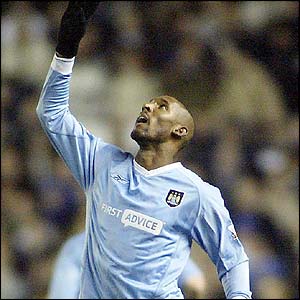
Anelka did eventually convert, taking the name Abdul-Salam Bilal (though he is rarely referred to as such). Nicolas Anelka during his time at Manchester City (photo: BBC) Anelka’s teammate on the national team Franck Ribery has made headlines this year due to his stellar play with new club Bayern Munich. The French winger, whose former clubs include Galatasaray and Olympique Marseille, is as gifted as he is shy. Though he rarely talks to the media, he did say in 2006 of his conversion, “[a]s a kid, I spent all my time with Muslims. It is my choice. No one told me to do it. I prefer to keep my reasons to myself.”It is known that Ribery’s wife, who is French of Moroccan descent, played a role in his conversion to Islam. Since converting, Ribery has often displayed his piety on the field, as John Lichfield wrote in the Independent in 2006: “He raises his hands to Allah before every match: something that goes down fine in Istanbul or Marseilles but was less appreciated during his brief periods in Metz and Brest.” Franck Ribery (photo: Tiscali) Anelka and Ribery are not alone. Graham Spiers wrote in The (Glasgow) Herald in 2005 that “Ribery joined a trend in young French society by converting to Islam. Jacques Faty and Julien Faubert, two other prominent young French footballers, have done the same. Two French coaches have also become Muslims. Perhaps not surprisingly, they are men who have spent much of their careers traveling the world to ply their trade, including in mainly Muslim countries. Fabio-look alike Bruno Metsu rose to fame by leading Senegal to success at the 2002 World Cup. During his time coaching in West Africa, “Metsu had to convert to Islam to marry Rokhaya ‘Daba’ Ndiaye, and a fair part of the Senegalese press now calls him Abdul Karim.” The manager with the loveliest hair, Bruno Metsu (photo: Asian Football Confederation) Philippe Troussier is known by his nickname “The White Witch Doctor” due to his success managing several teams in Africa. After a stint coaching Japan at the 2002 World Cup, Troussier returned to Africa as manager of Morocco. He was fired from this job after only two months, but decided to remain in the country with his wife. In 2006, both Troussier and his wife converted to Islam, taking the new names Omar and Amina (hers had been Dominique). The currently unemployed manager recently spoke to a TV station about his conversion (they term it a reversion), but your French will have to be better than mine if you want to understand exactly what he had to say. Culture of Soccer is a blog about the beautiful game and the people who play it. It looks at the way soccer intersects with economics, politics, religion, history, ethnicity, race, immigration, identity, psychology, sexuality, and other aspects of culture. | | No comments for this item |
|
Last Updated ( Wednesday, 31 October 2007 )
|
|
| | << Start < Prev 1 2 3 4 5 Next > End >>
| | Results 19 - 27 of 37 |
|
|
|
Text Link Ads
- Ricardo Kaka stats, facts and views at SportsPundit.com. Hundreds of sports teams and players are listed and categorized there.
|
|